
Dog Bowl Size and Shape: Matching the Bowl to Flat Faces, Long Ears, and Deep Chests
By dogbowwow · Updated November 2, 2026
Disclosure: As an Amazon Associate we earn from qualifying purchases. This guide is educational and is not a substitute for advice from your veterinarian.
Most people buy a dog bowl the way they buy a mixing bowl: by how it looks next to the other dishes. Then the pug starts pushing his dinner into the corner with his nose, the basset dunks both ears into the water, and the Great Dane stoops to a bowl placed for a dog half her size.
Dog bowl size is not really about weight. It is about the shape of the face, the length of the ears, the depth of the chest and the amount of food in a typical meal. This guide walks through each of those, and ends with a table you can match to your own dog.
Quick Answer
Choose dog bowl size by your dog's face and meal volume, not just weight. Flat-faced breeds need shallow, wide bowls; long-eared dogs do better with narrower, deeper ones; deep-chested giants need a stable, wide base. Pick a bowl that holds the meal at about half full, with room for the muzzle, and a base that does not slide.
Start With the Face, Not the Weight
A weight chart can tell you roughly how much a dog eats. It tells you nothing about how they reach it. Two dogs of identical weight can have completely different faces: one has a long, narrow muzzle that reaches into a deep bowl easily, the other has a short, flat face that cannot.
Before you buy, look at your dog head-on and in profile. Measure the width of the muzzle at its broadest point and notice how far the nose projects beyond the lower jaw. Ask three questions. Can the dog get the tongue to the food without pressing the face into the rim? Do the ears fall into the bowl? Does the dog have to bend or stretch to reach it?
The answers decide the shape. Weight only helps afterward, when you choose the capacity.
Flat-Faced Breeds: Shallow, Wide and Easy to Reach
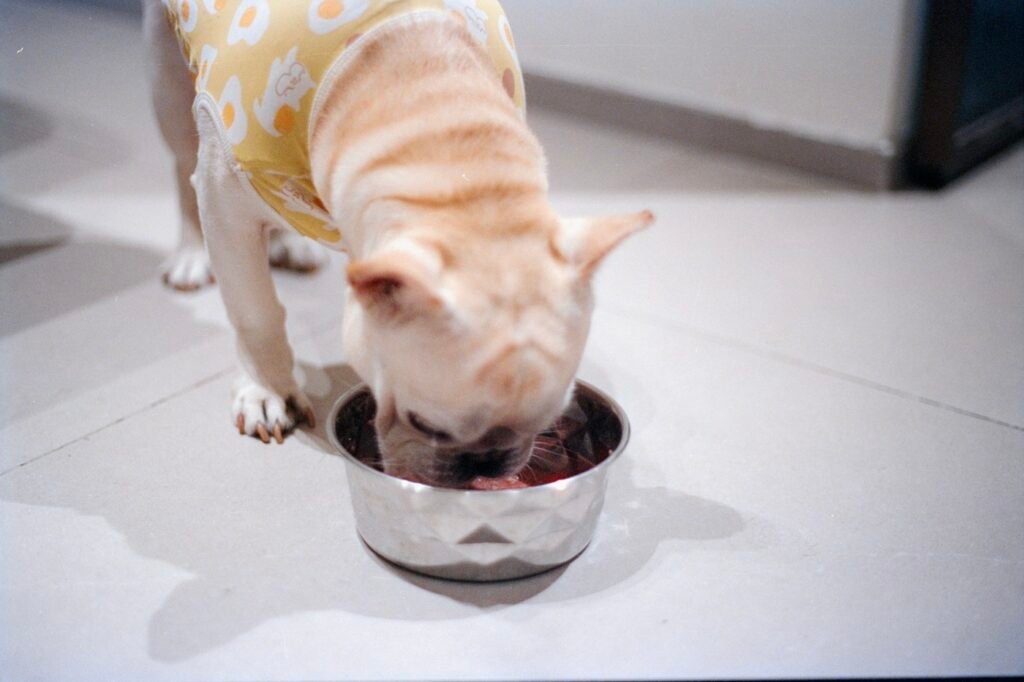
Dogs with short muzzles, such as pugs, bulldogs, Boston terriers and Shih Tzus, often struggle with deep, narrow bowls. They cannot get the lower jaw around food in a tight corner, and chasing kibble around the base can lead to frustration, swallowed air and a messy floor.
A shallow, wide bowl with gently sloping sides suits them best. A tilted or angled design can bring food forward so the dog does not have to dig. Keep the rim low and the surface smooth. If a flat-faced dog also eats fast, a slow feeder can help, but choose shallow ridges over deep mazes; see our guide to slow feeder bowls.
Flat-faced dogs can also have breathing difficulty during and after meals. If yours coughs, gags or struggles to breathe while eating, talk to your veterinarian.
Long Ears: Narrow Openings and Deeper Walls
For spaniels, bassets and other long-eared breeds, the problem is trailing ears: they dangle into the food or water, get wet and messy, and can be stepped on or chewed. Some dogs with wet, heavy ears are also more prone to ear trouble, though ear health is a topic for your vet.
Two approaches help. The first is a narrow, deeper bowl, wide enough for the muzzle but not much wider, so the ears hang outside the rim. The second is a snood or ear wrap, which holds the ears back during meals. Some owners use both.
Watch for a bowl that is too narrow. If the dog cannot get the whole muzzle in, or has to angle the head awkwardly, it defeats the purpose. Our look at bowl materials also helps if you are choosing between stainless and ceramic for easy daily washing.
Deep-Chested and Giant Dogs: Volume and Stance
Large, deep-chested dogs need a bigger bowl, but the main issue is stability and posture. A wide, heavy base keeps the bowl from skidding when a hungry dog goes in with force. A bowl that is too small means the dog scoops food onto the floor.
Some owners raise the bowl for tall dogs. That is a decision to make carefully, because for large and giant breeds there is a debated link between raised feeders and bloat. We explain the debate in our review of elevated dog bowls; ask your veterinarian before changing the height for a deep-chested dog.
Small and Toy Dogs: Low Rims and Small Targets
A toy dog does not need a miniature bucket. What matters is a low rim and a shallow depth so the dog can reach food without climbing or stretching. A heavy ceramic dish can be too heavy for a very small dog to nudge into position, while a very light plastic dish may skate away.
For tiny dogs, food needs to be easy to see and reach. A small, shallow, heavy-bottomed bowl is usually easier than a wide, shallow plate, which can leave a small dog chasing crumbs.
Match the Bowl to the Meal
A bowl that is too small makes a mess. One that is too big looks empty and encourages some dogs to push the food around. A useful rule of thumb is to choose a bowl where a typical meal fills about a third to half of the space, leaving room for the muzzle and for the food to move. That is an editorial rule, not a standard, so adjust to your dog.
To test, pour a normal meal into the bowl you are considering. If kibble reaches the rim or tumbles out, size up. If the food looks lost on a vast surface, size down.
Water works differently. A water bowl should hold enough that your dog is not scraping the bottom after a few laps. A commonly cited rule of thumb is that a dog drinks roughly an ounce of water per pound of body weight per day, but real needs vary with diet, weather and activity, so use it as a rough guide and not a target. If your dog is suddenly drinking much more or less than usual, that is a vet question, not a bowl one.
Tilted Bowls, Non-Slip Bases and Other Shape Tricks
Tilted bowls angle the food toward the dog’s mouth, so the last bites do not hide in a back corner. They can help small dogs and flat-faced breeds, and also help owners who want less scraping. Be aware that not all of them tilt enough to matter; look at the actual angle in photos.
Non-slip bases are worth checking for any dog who pushes. A rubber ring, a weighted base or a bowl that locks into a stand keeps it from walking across the floor. Our article on no-spill bowls and feeding mats goes further on how to keep the feeding area clean.
The Whisker Fatigue Claim
You may have seen claims that deep or narrow bowls cause “whisker fatigue,” a stress response said to arise when whiskers brush the sides of a bowl. It is a popular idea, particularly with cats, but it is not established science, and there is no solid evidence that it affects dogs. Some dogs may simply dislike the feel of a cramped bowl.
If your dog backs away from a deep bowl, picks food out, or eats from the edge, a wider bowl may help. You do not need to believe in whisker fatigue to try it, and you do not need to buy a special product to find out.
Quick Match by Dog Type
| Dog type | Recommended shape | Avoid |
|---|---|---|
| Flat-faced (pug, bulldog) | Shallow, wide, low rim; slightly tilted | Deep, narrow bowls and tall mazes |
| Long-eared (spaniel, basset) | Narrow, deeper bowl; optional snood | Wide, shallow plates |
| Deep-chested large breed | Large, wide, heavy base at floor level; vet input on height | Small or lightweight bowls |
| Toy or small dog | Low rim, shallow, stable | Large, high-walled bowls |
| Fast eater | Moderate depth with simple ridges | Very deep mazes that cause frustration |
| Puppy | Small, low-sided; plan to upsize | A big bowl bought for the adult dog |
| Senior with stiffness | Stable bowl, non-slip mat, easy reach | Light bowls that slide |
Advantages
- Shallow, wide bowls are easy for flat-faced and small dogs to reach.
- Narrow, deep bowls keep long ears clear of food and water.
- Heavy, wide bases keep large dogs from pushing the bowl across the room.
Drawbacks
- Shallow bowls let eager eaters flick food onto the floor.
- Narrow bowls can pinch the muzzle if you size too small.
- Specialty shapes cost more and are not always easier to clean.
Fitting Examples: A Pug, a Spaniel and a Great Dane Puppy
Picture a three-year-old pug who eats from a deep, narrow stainless bowl and often leaves a handful of kibble stuck at the bottom. Switching to a shallow, wide dish lets him eat in a few clean scoops and cuts the number of crumbs on the floor.
Picture a young cocker spaniel who comes away from every drink with sopping ears. A narrow, deeper bowl and a soft snood during meals keep the ears out of the water, and the owner saves on towels.
Picture a five-month-old Great Dane puppy. The owner buys a bowl suited to the full-grown dog, and the puppy struggles to reach inside it. A mid-sized bowl for now, upsized as he grows, works better.
Sizing Slips Worth Avoiding
- Buying by breed label alone. Individual dogs vary in muzzle length and ear size even within a breed.
- Sizing for the grown dog too early. Puppies need a bowl that suits them now.
- Ignoring the base. A well-shaped bowl that skates across the floor does not help.
- Using one bowl for everything. Food and water bowls can differ in size and shape.
- Over-filling. A bowl filled to the brim ends up on the floor.
- Forgetting the clean. Deep corners and ridges collect residue; see our guide on how to clean dog bowls.
For general background on breed-related care, the FDA guidance on safe pet-food handling and the FDA guidance on safe pet-food handling are helpful, and your veterinarian can advise on any mouth, jaw or breathing issues that affect eating.
Frequently Asked Questions
What size bowl does a puppy need?
A small, low-sided bowl that the puppy can reach into comfortably. Replace it as the puppy grows, and avoid buying the adult-sized bowl too early.
Does bowl depth affect digestion?
There is no strong evidence that depth changes digestion. Depth matters mainly for reach and comfort, and for flat-faced dogs, shallow bowls often help them eat without struggling.
Should I use a separate bowl for water?
Yes, usually. Water bowls benefit from a larger volume and a wide, stable shape, while food bowls are sized to the meal.
How do I stop my dog’s ears from dipping in the bowl?
A narrower, deeper bowl keeps ears outside the rim. A snood or ear wrap during meals does the same job. Check ears regularly and ask your vet about any redness or odor.
Are tilted bowls worth it?
They can help small dogs and flat-faced breeds reach the last bites. Check the angle in the listing, and make sure the bowl is stable and washable.
My dog eats from the edge of the bowl. Is that a problem?
It might just be a preference, or it could mean the bowl is too narrow, deep or unstable. Try a wider, shallower bowl on a non-slip surface. If your dog is also reluctant to eat or seems to be in pain, mention it to your vet.
Watch One Meal Before You Buy Another Bowl
Stand back at the next mealtime and watch. Does the nose bump the rim? Do the ears dip? Does the bowl slide? Each answer points to a specific fix, and a minute of observation will do more for you than a dozen product pages.